Building a D2C Brand in India? Here Are the 6Legal Boxes You Must Tick First:
India’s D2C market crossed $60 billion in 2025. Mamaearth, boAt, Lenskart — the proof of concept is well-established. What’s less discussed is the compliance stack sitting beneath every one of those brands, and what happens when a new founder skips it. The answer: seized shipments, forced rebrands, marketplace de-listings, and penalty notices that arrive long […]
India’s D2C market crossed $60 billion in 2025. Mamaearth, boAt, Lenskart — the proof of concept is well-established. What’s less discussed is the compliance stack sitting beneath every one of those brands, and what happens when a new founder skips it.
The answer: seized shipments, forced rebrands, marketplace de-listings, and penalty notices that arrive long after your first sale. The six requirements below aren’t optional extras — they’re the legal floor your D2C brand must be built on before the first order ships.
📌 TL;DR: Every D2C brand operating in India needs a registered business entity, GST registration, a trademark application, product-specific licences (FSSAI, BIS, or CDSCO depending on your category), Legal Metrology-compliant labelling, and Consumer Protection E-Commerce Rules compliance. Miss any one of these and you’re trading on borrowed time. Lawizer helps D2C founders get all of it done — fully online, from incorporation to trademark — without needing a CA in the room.
What You’ll Learn
- Why GST registration is mandatory even if your turnover is ₹0
- What the Legal Metrology Act means for your product packaging and your website listing
- Which product-specific licence your category actually needs
- How the DPDP Act, 2023 changes what your checkout page must look like

Box 1: Register the Right Business Entity
Most D2C founders start as sole proprietors and immediately run into a wall — payment gateways require a registered entity, marketplace onboarding is smoother with a PAN in the company’s name, and investors won’t touch a proprietorship.
A Private Limited Company is the recommended structure for any D2C brand with growth ambitions. It gives you limited liability, a clean cap table for future fundraising, and immediate credibility with marketplace category managers.
If you’re a bootstrapped solo founder testing a single SKU category, an LLP is a leaner starting point — lower compliance cost than a Pvt Ltd, more structure than a proprietorship. Either way, registration happens through the MCA’s SPICe+ form and typically takes 10–15 working days. This is always Step 1 because every subsequent registration — GST, trademark, bank account, payment gateway — flows from your Certificate of Incorporation and company PAN.
Lawizer handles startup and business legal registration end-to-end, including entity structuring advice if you’re undecided between Pvt Ltd and LLP.
Box 2: GST Registration — Mandatory from Sale Day One
Here’s the rule most D2C founders get wrong: the ₹40 lakh turnover threshold that exempts small businesses from GST does not apply to e-commerce sellers. Under Section 24 of the CGST Act, 2017, every person supplying goods through an e-commerce operator must register for GST regardless of turnover. If you’re selling on Amazon, Flipkart, Nykaa, or Meesho — even if you’ve made zero sales — you need a GSTIN before your first listing goes live.
If you sell only through your own D2C website with turnover under the threshold, the exemption technically applies — but the moment you list on any third-party marketplace, that window closes. Given that most D2C brands use a mix of owned and marketplace channels, the practical answer is: register for GST immediately after incorporation.
Your ongoing GST obligations include filing GSTR-1 (outward supply details), GSTR-3B (monthly summary return), and GSTR-9 (annual return), plus reconciling platform TCS (Tax Collected at Source) deductions from marketplaces against your actual liability. If your D2C brand stores inventory in warehouses across multiple states, you’ll also need GST registrations in each of those states — a requirement that catches fast-scaling brands off-guard.
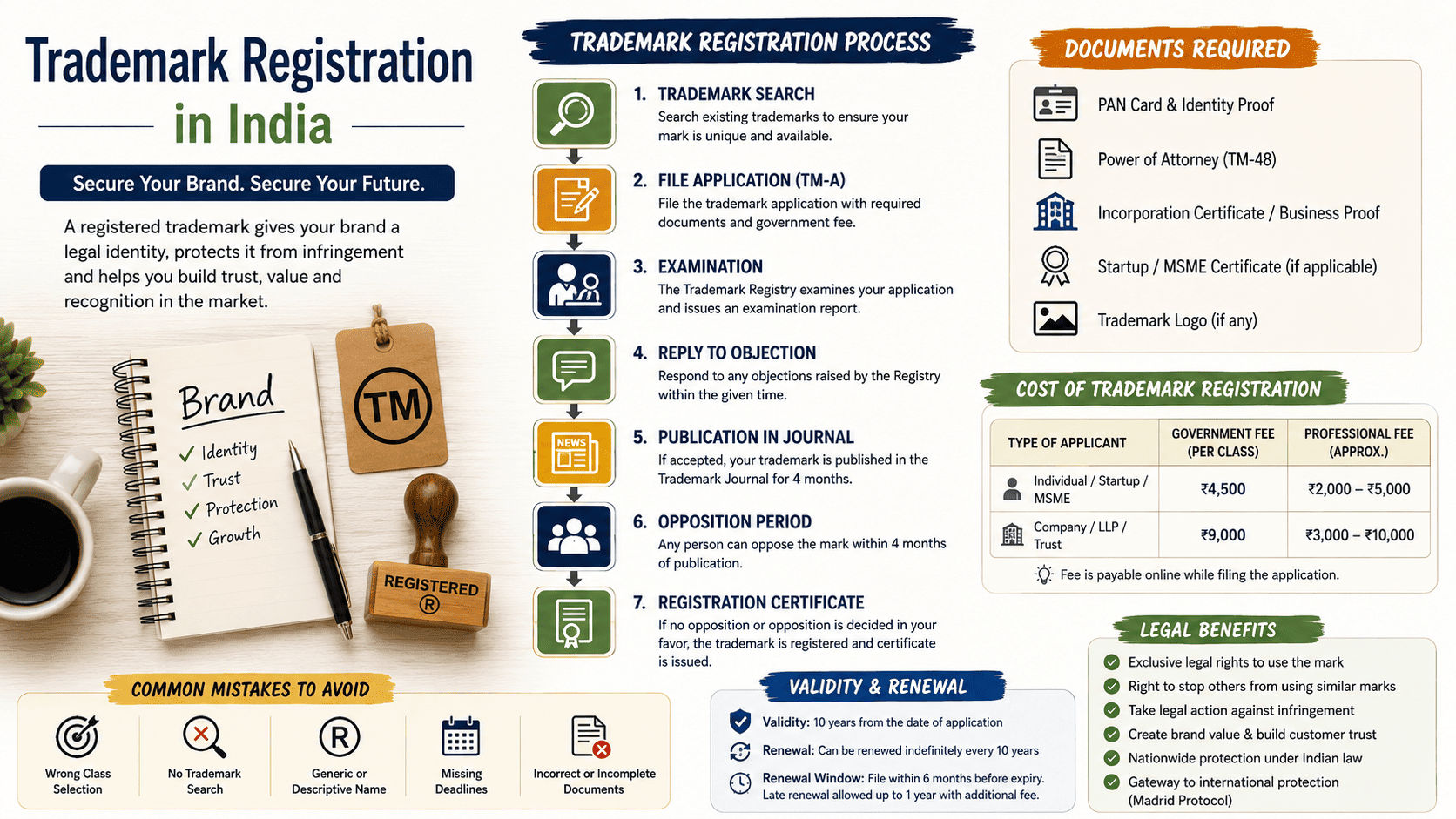
Box 3: File Your Trademark Early
A trademark is the cheapest insurance a D2C brand can buy. At ₹4,500 per class for small enterprises (under the current fee schedule), it protects your brand name and logo from being registered by a competitor — and in the D2C world, copycats move fast. Beyond legal protection, a registered trademark (or even a pending application with an acknowledgment number) is required for Amazon Brand Registry, which unlocks A+ content, brand analytics, and counter-counterfeiting tools that directly affect your conversion rate.
File in the right classes from day one. Common classes for D2C brands: Class 25 (clothing and footwear), Class 30 (food and beverages), Class 3 (cosmetics and personal care), Class 35 (online retail services). Most D2C brands need at least two classes — one for the product category and one for retail services. Registration takes 6–18 months from filing, but your protection date runs from the application date, not the registration date. File now.
Box 4: Product-Specific Licences — FSSAI, BIS, CDSCO
This is where D2C founders most often underestimate their compliance surface area.
FSSAI licence — mandatory for any brand selling food, beverages, dietary supplements, protein powders, health drinks, nutraceuticals, or even pet food. The licence tier depends on your annual turnover: registration for businesses up to ₹12 lakh turnover, state licence for ₹12 lakh to ₹20 crore, and central licence for above ₹20 crore or cross-state e-commerce. Operating without an FSSAI licence attracts a penalty of up to ₹5 lakh under Section 63 of the Food Safety and Standards Act, 2006. The 14-digit FSSAI licence number must appear on every product label and your website.
BIS certification — required for electronics, electrical goods, and certain consumer products covered under mandatory BIS product orders. If your D2C brand sells LED lights, power banks, helmets, or kitchen appliances, BIS certification (and the ISI mark) is non-negotiable before you list a single unit.
CDSCO approval — required for cosmetics under the Drugs and Cosmetics Act, 1940, as amended by the Cosmetics Rules, 2020. The key risk here: the moment your product makes a therapeutic claim (“reduces melanin production,” “treats acne”), it crosses from cosmetic to drug territory — triggering stricter regulations, and penalties including product seizure and imprisonment up to one year for misclassification.
Box 5: Legal Metrology Act Compliance — The One Every Category Misses
Most D2C founders associate compliance with the licences above. The Legal Metrology (Packaged Commodities) Rules, 2011 apply to every pre-packaged product sold in India — food, skincare, electronics, clothing, home décor, stationery, pet products. There are no exceptions for small businesses or D2C brands.
Every product package must display: product name, net quantity in standard units, MRP inclusive of all taxes (preceded by “MRP ₹”), manufacturer or packer name and registered address, month and year of manufacture, consumer care contact details (name, address, phone, and email), and country of origin for imported goods.
Critically, for e-commerce sellers, these declarations must appear not just on the physical packaging but also on the product listing page itself. Non-compliance carries a penalty of ₹25,000 to ₹50,000 per offence — and legal metrology officers can and do inspect marketplace listings.
One additional obligation that’s quietly become an enforcement focus in 2025: Extended Producer Responsibility (EPR) registration under plastic and e-waste rules. If your D2C brand uses plastic packaging, your EPR registration number must appear on the packaging. Failure to register is treated as a serious violation under solid waste and plastic management rules.
Box 6: Consumer Protection E-Commerce Rules, 2020 — and the DPDP Act, 2023
The Consumer Protection (E-Commerce) Rules, 2020 apply to every D2C brand selling online. Your website or app must display: complete product details with a total price breakdown (no hidden fees), your return and refund policy, cancellation terms, delivery timelines, and seller identity.
You are required to appoint a Grievance Officer, display that officer’s name and contact details on your platform, and resolve consumer complaints within 30 days. Violation attracts penalties under the Consumer Protection Act, 2019.
Layered on top of this is the Digital Personal Data Protection (DPDP) Act, 2023 — which changes what your checkout and data collection flows must look like. D2C brands collect significant customer data: names, addresses, payment information, browsing behaviour.
Under the DPDP Act, you must collect only what is necessary, provide a clear privacy policy, obtain explicit consent before collecting data, and enable customers to request data deletion. The penalty for non-compliance scales up to ₹250 crore — which is why building DPDP-compliant data practices into your website from launch is far cheaper than retrofitting them after a notice.
MSME or Udyam registration is also worth completing at this stage — it’s quick, free, and unlocks priority credit, marketplace benefits, and government tender eligibility as your brand scales.

How Long Does This All Take?
Company incorporation, GST, and Udyam registration can run in parallel — typically 15–20 working days combined. File your trademark application the same week as incorporation. Product-specific licences (FSSAI, BIS) run concurrently but may take longer depending on your category.
Total time from zero to first compliant sale: 30–60 days, with a total compliance cost typically between ₹15,000 and ₹50,000 depending on the entity structure and licences required.
The brands that build this foundation correctly don’t just avoid penalties — they get marketplace approvals faster, onboard payment gateways without delays, and walk into investor conversations with clean corporate records.
Frequently Asked Questions
Q: Is GST registration mandatory for a D2C brand that hasn’t made any sales yet? A: Yes, if you intend to sell through any third-party e-commerce platform. Section 24 of the CGST Act removes the turnover exemption for e-commerce sellers entirely. You need a GSTIN before your first listing goes live on any marketplace, regardless of whether any sales have occurred.
Q: Do I need a trademark even if I’m just starting out and unsure the brand will succeed? A: Yes — and the earlier the better. Trademark protection dates back to your application date, not your registration date. Filing early costs the same as filing later, but protects you from a copycat who registers your brand name while you’re waiting to see traction. An acknowledgment number from the IP India portal is also sufficient for Amazon Brand Registry.
Q: My D2C brand sells skincare. Do I need CDSCO approval or FSSAI? A: CDSCO (under the Drugs and Cosmetics Act, 1940 and Cosmetics Rules, 2020) governs cosmetics like serums, creams, and shampoos. FSSAI governs edible products. The critical line: if your skincare product makes a therapeutic claim (treats a condition, alters a biological process), it shifts from cosmetic to drug regulation — with significantly higher compliance requirements and penalties for misclassification.
Q: Does the Legal Metrology Act apply to my D2C website listing, or just the physical packaging? A: Both. Under amendments to the Legal Metrology (Packaged Commodities) Rules, e-commerce entities must display all mandatory declarations — MRP, net quantity, manufacturer details, and consumer care contacts — on the product listing page itself, not just on the physical label. Marketplace listings that omit these are actively flagged during inspections.
Q: What does the DPDP Act, 2023 require from a D2C brand’s website? A: The Digital Personal Data Protection Act, 2023 requires D2C brands to collect only data that is necessary for the stated purpose, display a clear and accessible privacy policy, obtain explicit consent before collecting personal data, and provide customers with a mechanism to request correction or deletion of their data. Non-compliance penalties scale up to ₹250 crore — making early implementation far more cost-effective than corrective compliance after a notice.
Q: Can Lawizer handle all six of these registrations as a single project? A: Yes. Lawizer handles company incorporation, GST registration, trademark filing, FSSAI licensing, and Udyam registration — fully online, with no CA visit required. Starting your business registration correctly from day one means you’re eligible for marketplace onboarding, payment gateway integration, and investor due diligence from launch.
Ready to launch your D2C brand on solid legal ground? Lawizer gets your company registered, GST filed, trademark applied, and sector licences in place — fully online, starting at ₹4,999. No office visits, no missed boxes.
Start your D2C brand registration →