GST Composition Scheme
GST Composition Scheme: Eligibility, Rates & Rules The GST composition scheme is a simplified tax option designed for eligible small businesses in India. Instead of following the full compliance framework applicable to regular GST taxpayers, qualifying businesses can pay tax at prescribed composition rates and follow a simpler return and payment structure. However, lower compliance […]
GST Composition Scheme: Eligibility, Rates & Rules
The GST composition scheme is a simplified tax option designed for eligible small businesses in India. Instead of following the full compliance framework applicable to regular GST taxpayers, qualifying businesses can pay tax at prescribed composition rates and follow a simpler return and payment structure.
However, lower compliance does not automatically mean the scheme is better for every business. Composition taxpayers generally cannot claim input tax credit (ITC), cannot collect GST separately from customers and face restrictions on certain supplies.
For a founder, retailer, manufacturer, restaurant owner or small service provider, the right choice depends on turnover, customers, purchases and growth plans. This guide explains the eligibility rules, rates, CMP-08, GSTR-4 and the key differences between composition and regular GST.
If you are not yet registered, you can also read Lawizer’s GST registration guide for small shop owners or explore its GST registration service.
What Is the GST Composition Scheme and How Does It Work?
The composition levy is provided under Section 10 of the Central Goods and Services Tax Act, 2017. Its purpose is to reduce the compliance burden for smaller eligible taxpayers.
A regular GST taxpayer generally calculates GST on taxable supplies, collects the applicable tax from customers and may claim eligible ITC on business purchases. A composition taxpayer follows a different model.
Broadly, a composition taxpayer:
- pays tax at the prescribed composition rate;
- does not collect GST separately from customers;
- issues a bill of supply instead of a normal GST tax invoice;
- cannot claim input tax credit on purchases;
- pays self-assessed tax through CMP-08 quarterly; and
- files the applicable annual return in Form GSTR-4.
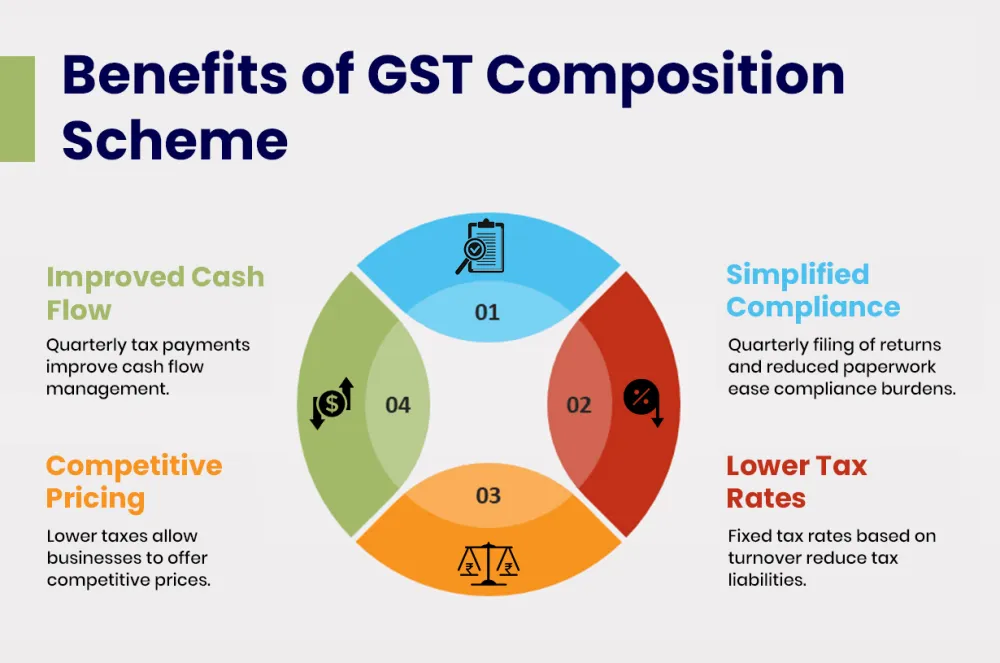
The scheme can therefore make compliance easier, particularly for small businesses selling mainly to end consumers. However, the loss of ITC and supply restrictions mean that businesses should compare both regimes before opting in.
The statutory framework can be checked through the Central Board of Indirect Taxes and Customs (CBIC) and compliance filings are made through the official GST portal.
GST Composition Scheme Eligibility: Who Can Opt In?
Eligibility depends on the nature of the business, aggregate turnover in the preceding financial year and satisfaction of the conditions prescribed under GST law.
Turnover Limit Under the GST Composition Scheme
For the standard composition levy, the commonly applicable aggregate-turnover ceiling is ₹1.5 crore in the preceding financial year. A lower ceiling of ₹75 lakh applies in specified states.
For eligible suppliers of services or mixed supplies opting for the separate scheme under Section 10(2A), the turnover ceiling is ₹50 lakh in the preceding financial year.
These figures concern eligibility for the composition levy. They should not be confused with the separate turnover thresholds that determine when GST registration itself becomes compulsory.
Aggregate turnover is PAN-based. Therefore, a business owner should consider relevant turnover across registrations under the same PAN rather than looking at only one shop or GST registration in isolation.
Who Can Be a Composition Dealer?
Subject to the applicable conditions, the scheme may be available to categories such as:
- eligible traders and retailers;
- eligible manufacturers;
- restaurants and specified food-service businesses covered by the composition provisions; and
- eligible service providers or businesses making mixed supplies under the 6% scheme.
Businesses approaching the threshold should monitor turnover throughout the year. If you are still determining whether GST registration applies to you, see Lawizer’s step-by-step GST registration guide.
Who Is Not Eligible for the GST Composition Scheme?
The scheme is not available merely because a business is small. Several statutory exclusions and conditions apply.
Depending on the relevant provision, restrictions can cover:
- casual taxable persons;
- non-resident taxable persons;
- persons making prohibited inter-State outward supplies;
- manufacturers of certain notified goods, such as specified tobacco products, pan masala and ice cream; and
- businesses that otherwise fail the conditions under Section 10 and the applicable GST Rules.
There is also an important e-commerce update. Older guidance often states that composition dealers cannot sell goods through e-commerce operators. That is no longer a complete statement of the law.
From 1 October 2023, composition taxpayers can make eligible intra-State supplies of goods through e-commerce operators, subject to the prescribed procedure. The e-commerce operator must comply with requirements including TCS and GSTR-8 reporting where applicable. Inter-State outward supply of goods remains restricted. The relaxation for goods should not be assumed to apply to services supplied through an e-commerce operator.
GST Composition Scheme Tax Rates
The applicable rate depends on the taxpayer’s category. The commonly applicable combined rates are:
| Business Category | Combined Rate | General Turnover Ceiling* |
|---|---|---|
| Eligible manufacturers | 1% | ₹1.5 crore |
| Eligible traders/other suppliers covered by the standard scheme | 1% | ₹1.5 crore |
| Eligible restaurant services | 5% | ₹1.5 crore |
| Eligible service/mixed suppliers under Section 10(2A) | 6% | ₹50 lakh |
*A lower ₹75 lakh limit applies for the standard scheme in specified states. Eligibility is subject to all applicable statutory conditions.
The combined 1% rate generally consists of 0.5% CGST and 0.5% SGST/UTGST. Similarly, the 5% restaurant rate generally consists of 2.5% plus 2.5%, while the 6% rate under the service-provider scheme generally consists of 3% plus 3%.
Example of Composition Tax Calculation
Suppose an eligible trader has relevant turnover of ₹80 lakh and the applicable composition rate is 1%. A simple illustration would produce a composition tax amount of ₹80,000.
That does not mean the composition scheme necessarily saves more tax than the regular scheme. A regular taxpayer may be able to claim eligible ITC, whereas a composition taxpayer cannot. The correct comparison therefore depends on purchases, margins, customer profile and the nature of supplies.
GST Composition Scheme vs Regular GST: Which Is Better?
Neither system is universally better. The composition option prioritises simplicity, while the regular GST regime provides greater flexibility and access to input tax credit.
| Factor | Composition Scheme | Regular GST |
|---|---|---|
| Input Tax Credit | Not available | Available subject to conditions |
| Collect GST separately | No | Yes |
| Customer document | Bill of supply | Tax invoice, where applicable |
| Compliance | Simplified | More extensive |
| Inter-State outward supplies | Restricted | Generally permitted |
| Best suited to | Many small, local B2C businesses | Growing, B2B or ITC-intensive businesses |
Advantages of the Composition Scheme
- Simpler compliance: The filing framework is less extensive than regular GST compliance.
- Predictable tax calculation: Tax is calculated using the prescribed composition rate.
- Reduced administrative burden: Small businesses may spend less time managing detailed GST compliance.
- Useful for some B2C businesses: End consumers generally do not require ITC, making the absence of an ITC-enabled invoice less commercially significant.
Disadvantages of the GST Composition Scheme
- No ITC: GST paid on eligible purchases cannot be claimed as input tax credit.
- No separate collection of GST: A composition taxpayer cannot separately recover GST from customers in the manner of a regular taxpayer.
- B2B disadvantage: GST-registered customers may prefer suppliers whose invoices allow them to claim eligible ITC.
- Inter-State restrictions: Businesses planning to sell across state borders may find the scheme unsuitable.
- Turnover ceiling: A fast-growing business may have to move out of the scheme after it ceases to satisfy the conditions.
If your business is still at an early stage, it may also be useful to review Lawizer’s startup and business legal services and MSME/Udyam registration service.
What Are CMP-08 and GSTR-4?
Composition taxpayers do not follow exactly the same return framework as ordinary taxpayers. Two important forms are CMP-08 and GSTR-4.
What Is CMP-08?
Form GST CMP-08 is a statement for payment of self-assessed tax by taxpayers under the composition scheme. It is furnished quarterly.
It allows the taxpayer to declare the relevant figures and discharge the composition tax liability for the quarter. Businesses should check the current filing calendar on the GST portal rather than relying on an old compliance calendar, because extensions or procedural changes may occasionally be notified.
What Is GSTR-4?
GSTR-4 is the annual return applicable to composition taxpayers for the relevant period under the current return framework.
In simple terms, CMP-08 handles quarterly tax payment information, while GSTR-4 provides the annual return. Both should be distinguished from the returns generally associated with regular GST taxpayers.
GSTR-1, GSTR-2A, GSTR-2B and GSTR-3B Explained
- GSTR-1: statement containing details of outward supplies furnished by applicable registered taxpayers.
- GSTR-2A: an auto-populated and dynamic statement of inward-supply information.
- GSTR-2B: an auto-drafted ITC statement used by regular taxpayers for ITC-related reconciliation.
- GSTR-3B: the summary return through which applicable regular taxpayers declare liabilities and discharge tax.
- GSTR-4: the annual return applicable to composition taxpayers under the current composition return framework.
A composition taxpayer generally does not claim ITC, so the role of GSTR-2B is particularly relevant when comparing composition taxation with regular GST compliance.
Is a CA Required for GST Filing?
No general rule requires every taxpayer to hire a Chartered Accountant merely to submit a GST return. Taxpayers can file applicable forms themselves through the GST portal.
Professional assistance can nevertheless be valuable when a business has complex supplies, multiple registrations, reverse-charge issues, reconciliations, notices or uncertainty about eligibility.
How to Opt for the GST Composition Scheme
A new applicant can indicate the relevant composition option during the GST registration process, subject to eligibility.
An existing registered taxpayer who wants to opt for composition for a financial year generally uses Form GST CMP-02 within the prescribed process and timeline. The option for an existing taxpayer takes effect from the beginning of the relevant financial year, subject to the applicable rules.
Moving from the regular scheme to composition can also involve ITC-related adjustments on stock and other items. Businesses should therefore avoid treating the switch as only a checkbox on the GST portal.
For assistance with a new registration, see Lawizer’s online GST registration service.
What Happens If You Become Ineligible?
A taxpayer cannot continue paying composition tax after ceasing to satisfy the applicable conditions. For example, crossing the applicable turnover ceiling can cause the composition option to lapse from the date specified under the law.
Form GST CMP-04 is used for withdrawal from the composition levy in applicable circumstances. Transitioning back to the regular scheme can also affect invoicing, ITC and stock records.
Because the consequences depend on the facts and timing, a growing business should review its turnover before it gets too close to the ceiling.
Who Should Consider the GST Composition Scheme?
The scheme can be attractive where a business is small, locally focused and primarily sells to consumers who do not need input tax credit.
It may be worth considering if:
- most customers are end consumers;
- the business operates predominantly within one state;
- GST-bearing business inputs are relatively limited;
- turnover is comfortably within the applicable ceiling; and
- simplified compliance is a priority.
Regular GST may be more suitable where:
- customers are primarily GST-registered businesses that value ITC;
- the business makes or plans significant inter-State outward supplies;
- purchases generate substantial eligible input tax credit;
- the business expects rapid turnover growth; or
- its operating model does not satisfy composition conditions.
The tax rate alone should never determine the decision. A 1% composition rate can appear attractive, but losing ITC may materially change the economics of the business.
Frequently Asked Questions About the GST Composition Scheme
What is the 6% GST composition scheme and who is eligible for it?
Section 10(2A) provides a composition-style option for eligible registered persons who are not eligible for the standard composition levy and whose aggregate turnover in the preceding financial year does not exceed the prescribed ₹50 lakh ceiling. The combined rate is generally 6%, split between CGST and SGST/UTGST. All statutory conditions must still be satisfied.
How does the GST composition scheme work?
An eligible taxpayer opts for composition, pays tax at the prescribed rate and follows the simplified composition compliance framework. The taxpayer generally cannot collect GST separately from customers or claim input tax credit and must comply with the applicable supply restrictions.
Who is eligible for the GST composition scheme?
Eligible small manufacturers, traders, specified restaurant businesses and certain service or mixed suppliers may qualify, depending on turnover and the other requirements of Section 10 and the GST Rules.
How much turnover is required for the GST composition scheme?
There is no general minimum turnover that a business must achieve specifically to use composition. Instead, the scheme sets maximum eligibility ceilings. The standard scheme generally uses a ₹1.5 crore ceiling in the preceding financial year, reduced to ₹75 lakh in specified states, while the separate service/mixed-supply option has a ₹50 lakh ceiling.
Who is not eligible for the GST composition scheme?
Examples include casual taxable persons, non-resident taxable persons and businesses that make supplies or manufacture goods prohibited under the applicable composition provisions. Inter-State outward supplies remain a major restriction.
Can a composition dealer sell through Amazon, Flipkart or another e-commerce operator?
Eligible composition taxpayers have been permitted to make intra-State supplies of goods through e-commerce operators from 1 October 2023, subject to the prescribed procedure. Inter-State supplies of goods remain prohibited for composition taxpayers. Businesses supplying services through e-commerce operators need separate eligibility analysis.
Which is better: composition or regular GST?
Composition may work well for a small local B2C business with limited ITC. Regular GST can be preferable for B2B businesses, businesses with substantial GST-bearing inputs, inter-State operations or companies expecting rapid growth.
What are CMP-08 and GSTR-4?
CMP-08 is the quarterly statement used for payment of self-assessed composition tax. GSTR-4 is the annual return applicable to composition taxpayers under the current framework.
Who is eligible for GSTR-3B?
GSTR-3B applies to registered persons required to furnish that return under the regular GST framework, subject to applicable exclusions and rules. Composition taxpayers instead follow the composition return and payment framework.
What is the difference between GSTR-1, GSTR-2B and GSTR-3B?
GSTR-1 reports outward-supply details. GSTR-2B is an auto-drafted ITC statement based on information furnished by suppliers and other sources. GSTR-3B is a summary return used by applicable taxpayers to declare liabilities and discharge tax.
Is a CA required for GST filing?
No. GST law does not require every taxpayer to hire a CA simply to file routine GST forms. However, professional assistance can be useful for complex transactions, notices, reconciliations and questions about eligibility.
What are the four types of GST in India?
The four commonly discussed components are CGST, SGST, IGST and UTGST. CGST and SGST/UTGST generally apply to intra-State or intra-Union Territory supplies as relevant, while IGST generally applies to inter-State supplies.
What are the new GST rates and slabs in India in 2026?
GST rates depend on the classification of the particular goods or services and current notifications. Businesses should not assume that a proposed GST Council recommendation has become law until the relevant notification or legislative change takes effect. Composition rates are also different from the ordinary GST rate applicable to a product or service.
Is GST going to increase in 2026?
There is no single GST rate that automatically increases for every business. Rate changes depend on the relevant goods or services and legally effective notifications. Businesses should check CBIC and GST Council updates rather than relying on predictions or social-media posts.
What are the disadvantages of the GST composition scheme?
The major disadvantages include the inability to claim ITC, inability to collect GST separately from customers, restrictions on inter-State outward supplies and potential disadvantages when selling to B2B customers that want ITC-eligible invoices.
Final Takeaway
The composition scheme can significantly simplify GST compliance for an eligible small business, but simplicity should not be confused with universal tax savings.
A local B2C retailer may benefit from the simpler framework. A growing B2B company with substantial input GST or plans for inter-State expansion may find regular GST more practical.
Before opting in, review your aggregate turnover, customer mix, input taxes, supply locations and expected growth. Also verify the latest notifications because GST procedures and exemptions can change.
For related compliance, explore Lawizer’s GST registration support, MSME/Udyam registration, trademark registration and legal and tax guides for Indian businesses.
Need Help Choosing the Right GST Option?
Choosing between composition and regular GST can affect your tax costs, invoicing, input tax credit and future expansion. Lawizer can help you understand the applicable registration and compliance requirements based on your business model.
Consult Lawizer about GST registration and compliance before selecting or changing your GST option.
Disclaimer: This article provides general information and is not legal or tax advice. GST eligibility and compliance depend on the facts of each business and the law and notifications in force at the relevant time.