How to File GST Returns in India
How to File GST Returns: Step-by-Step Guide For many Indian founders and small-business owners, how to file GST returns is one of the first compliance questions that comes after obtaining a GST registration. The process is online, but accurate filing requires more than simply entering a few numbers on the GST Portal. You need to […]
How to File GST Returns: Step-by-Step Guide
For many Indian founders and small-business owners, how to file GST returns is one of the first compliance questions that comes after obtaining a GST registration. The process is online, but accurate filing requires more than simply entering a few numbers on the GST Portal.
You need to understand which return applies to your business, organise your sales and purchase records, check your input tax credit, reconcile the relevant data and file the return within the applicable deadline.
This guide explains the GST return filing process in simple terms. It covers GSTR-1, GSTR-2B, GSTR-3B, eligibility, due dates, nil returns, filing without a CA, turnover thresholds, late filing and important GST Portal changes relevant to businesses in 2026.
If you have not yet obtained GST registration, you can first review Lawizer’s GST registration service and its guide on GST registration for startups.
What Is a GST Return and How Does It Work?
A GST return is a statement or return that a registered taxpayer furnishes to report relevant supplies, tax liability, input tax credit and other prescribed information for a tax period.
For a regular taxpayer, two forms are particularly important: GSTR-1 and GSTR-3B. GSTR-1 primarily reports outward supplies, while GSTR-3B is a summary return used to report tax liabilities and eligible input tax credit and to discharge the resulting tax liability.
GST compliance therefore involves more than filing a form. Your invoices, accounting records, outward supplies, purchase records and input tax credit should support the figures reported on the GST Portal.
The exact compliance requirements can vary according to your registration type, filing frequency and applicable GST provisions.
What Are GSTR-1, GSTR-2B and GSTR-3B?
What is GSTR-1?
GSTR-1 is the statement of outward supplies. Regular and casual taxpayers who are required to furnish it report relevant details of their outward supplies of goods and services through this form.
Depending on the nature of the transactions, GSTR-1 can include details such as:
- Supplies made to registered customers.
- Relevant supplies made to unregistered customers.
- Exports and supplies to SEZs, where applicable.
- Credit notes and debit notes.
- Amendments to previously reported information.
- HSN or SAC-related summary information.
- Other prescribed outward-supply information.
The GST Portal currently provides online and offline methods for preparing GSTR-1. Taxpayers should review the generated summary carefully before filing because information becomes part of the filed statement.
What is GSTR-2B?
GSTR-2B is an auto-drafted statement that helps a recipient review invoice information reported by suppliers and assess input tax credit for the relevant period.
It is important to remember that GSTR-2B is not the same as GSTR-3B. It is a statement used as an important reconciliation reference when determining eligible ITC.
Businesses should compare their purchase records with GSTR-2B and investigate differences before claiming credit.
What is GSTR-3B?
GSTR-3B is a summary return through which eligible taxpayers report relevant outward supplies, inward supplies liable to reverse charge, input tax credit and tax payable for the tax period.
After determining the liability and eligible credit, the taxpayer pays the balance tax, where applicable, and files the return electronically.
How do GSTR-1, GSTR-2B and GSTR-3B work together?
A simple way to understand the relationship is:
- GSTR-1: Report relevant outward supplies.
- GSTR-2B: Review supplier-reported information relevant to ITC.
- GSTR-3B: Report the summary liability and eligible ITC and pay the resulting tax.
This is why reconciliation should be completed before filing. A difference between sales records, GSTR-1 and GSTR-3B can create compliance issues.
For businesses that need broader compliance support, Lawizer also provides annual compliance services.
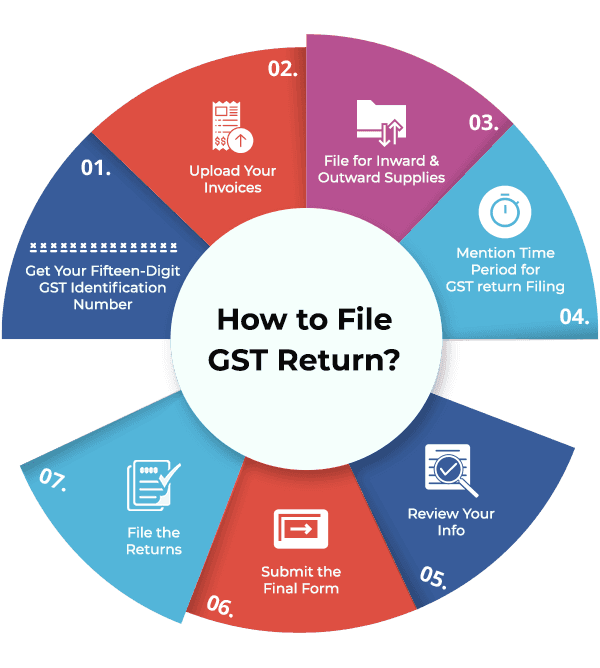
How to File GST Returns Online in India
The basic process is straightforward when your records are organised. The following steps explain the usual process for a regular taxpayer.
Step 1: Keep your GST records ready
Before logging into the GST Portal, collect the information required for the relevant tax period.
- GSTIN and GST Portal login credentials.
- Sales invoices and outward-supply records.
- Purchase invoices and expense records.
- Credit notes and debit notes.
- Export or SEZ documents, where applicable.
- Records relevant to reverse-charge transactions.
- GSTR-2B for reviewing ITC.
- Details of previous-period adjustments or amendments.
- Tax payment and electronic ledger information, where applicable.
Keeping these records organised before filing reduces the risk of entering incomplete or inconsistent information.
Step 2: Log in to the GST Portal
Visit the official GST Portal and log in using your credentials.
From the relevant services and returns section, select the financial year and tax period for which the return is due. The Portal displays the return tiles applicable to the taxpayer.
Step 3: Prepare GSTR-1
For taxpayers required to file GSTR-1, enter or upload the applicable outward-supply information.
Depending on your transactions, this may involve B2B invoices, relevant B2C supplies, exports, credit notes, debit notes, amendments and HSN/SAC information.
The GST Portal also supports offline preparation for GSTR-1. Businesses with a large number of invoices may find structured accounting or invoicing records useful for reducing manual errors.
Step 4: Review and generate the GSTR-1 summary
Review the information before filing. The GST Portal allows taxpayers to generate a summary and preview the information before final filing.
Check important details such as:
- GSTINs of customers.
- Invoice numbers and dates.
- Taxable values.
- Applicable tax rates.
- CGST, SGST/UTGST and IGST amounts.
- Credit and debit notes.
- Exports and other special categories.
Once the information has been reviewed, complete the applicable filing and verification process.
Step 5: Reconcile GSTR-2B with your purchase records
Before finalising GSTR-3B, compare the ITC reflected in GSTR-2B with your books and purchase invoices.
Do not assume that every amount appearing in a system-generated statement automatically becomes eligible ITC. Eligibility depends on the applicable GST provisions and the facts of the transaction.
Look for issues such as:
- Invoices missing from your records.
- Invoices recorded by suppliers but not matching your books.
- Incorrect GSTIN details.
- Duplicate entries.
- Credit notes requiring adjustment.
- Ineligible or restricted ITC.
Step 6: Prepare GSTR-3B
After reviewing the relevant data, prepare GSTR-3B for the applicable tax period.
Review the figures relating to outward supplies, reverse-charge liabilities, eligible ITC and tax payable. The GST Portal may auto-populate certain information, but taxpayers remain responsible for checking their return and reporting the correct figures.
For delayed filing, the Portal may also calculate or auto-populate interest in accordance with the applicable rules and system functionality.
Step 7: Pay the applicable tax
If tax remains payable after considering the permitted input tax credit and available balances, make the required payment through the GST payment mechanism.
Review the amount carefully before offsetting the liability. Keep the relevant challans and payment records with your accounting documents.
Step 8: File the return and save the acknowledgement
After reviewing the return, complete the applicable electronic verification process. Depending on the taxpayer and filing method, the GST Portal provides options such as EVC or DSC where applicable.
After successful filing, save the acknowledgement/reference details and download the filed return for your records.
The GST Portal’s official guidance provides detailed instructions for filing GSTR-1 and filing GSTR-3B.
Who Needs to File GST Returns?
GST return obligations depend on the taxpayer’s registration type and the scheme under which the taxpayer operates.
Regular taxpayers generally have GSTR-1 and GSTR-3B obligations, subject to the applicable rules. Certain categories, such as composition taxpayers and specific specialised taxpayers, follow different compliance requirements.
The GST Portal states that GSTR-1 is generally applicable to normal and casual registered taxpayers making outward supplies, while specified categories are excluded.
Do you need to file a GST return if there are no sales?
In many cases, a registered taxpayer still needs to furnish the applicable return even when there is no business activity. A nil return may be appropriate when the conditions for a nil filing are satisfied.
For example, the GST Portal states that a nil GSTR-3B can be filed when the relevant conditions are satisfied, including no outward supply, no inward supply and no tax liability for the period.
Always check the Portal’s current eligibility conditions before filing a nil return.
What Are the GST Return Due Dates?
GST due dates depend on the return, filing frequency, taxpayer category and any extension notified by the Government.
For many regular taxpayers, the commonly applicable dates are:
- GSTR-1 monthly filing: generally the 11th of the following month.
- GSTR-1 quarterly filing: generally the 13th of the month following the quarter.
- GSTR-3B monthly filing: generally the 20th of the following month.
- GSTR-3B under QRMP: generally the 22nd or 24th of the month following the quarter, depending on the applicable State or Union Territory category.
These are general dates rather than a substitute for checking the return dashboard. Government notifications can extend or modify deadlines for specific periods or taxpayers.
If you use the QRMP scheme, the GST Portal states that eligible taxpayers with aggregate annual turnover up to ₹5 crore can file GSTR-1 and GSTR-3B quarterly, subject to the scheme’s conditions.
Check the GST Portal for the deadline displayed for your specific return period.
Can You File GST Returns Without a CA?
Yes. A taxpayer can generally prepare and file applicable GST returns directly through the GST Portal without appointing a Chartered Accountant.
The GST Portal provides online filing facilities, and GSTR-1 can also be prepared using available offline tools.
However, self-filing requires you to understand your transactions and maintain accurate records. Professional assistance can be useful when the business has complex transactions, significant ITC, multiple registrations, reconciliations, notices or recurring filing differences.
How much does a CA charge to file a GST return?
There is no single statutory CA fee for GST return preparation that applies to every business. Professional fees can vary depending on factors such as:
- Number of invoices.
- Monthly or quarterly filing frequency.
- Nature and complexity of transactions.
- ITC reconciliation requirements.
- Number of GST registrations.
- Whether accounting and bookkeeping are included.
- Whether notices or additional compliance work are involved.
Ask for a clear scope of work before engaging a professional so that you know what is included in the quoted fee.
Do You Need GST If Your Turnover Is Below ₹20 Lakh?
The answer is not always simply yes or no.
GST registration thresholds depend on factors including the nature of the supplies, the State or Union Territory, and whether a compulsory-registration provision applies.
Under the general framework, the CGST Act contains a basic registration threshold of ₹20 lakh for taxable suppliers, with different provisions and higher thresholds applying in specified circumstances. For example, eligible suppliers dealing exclusively in goods may have a higher threshold in many States, subject to the conditions prescribed under the law.
There are also categories where registration can become compulsory even when turnover is below the normal threshold. Therefore, turnover alone should not be used as the only test.
Before relying on a turnover exemption, check the current law and your exact business model. You can also read Lawizer’s GST registration guide for small shop owners for a broader explanation of registration considerations.
How much turnover is allowed without GST?
There is no universal turnover number that applies to every business.
The applicable threshold can depend on whether you supply goods or services, where your business operates and whether a compulsory-registration provision applies.
This distinction is important because a business with turnover below a commonly quoted threshold may still have a GST registration obligation in certain circumstances.
How much GST is payable on ₹10 lakh turnover?
There is no single GST amount simply because turnover is ₹10 lakh.
GST liability depends on the nature of taxable supplies, the applicable GST rate, exempt or non-taxable supplies, place-of-supply rules, eligible ITC and other relevant provisions.
For example, ₹10 lakh of taxable supplies at one GST rate will produce a different output-tax figure from ₹10 lakh of taxable supplies subject to another rate. Therefore, turnover should not be multiplied by an assumed GST rate without examining the underlying transactions.
What Happens If You Miss a GST Return Deadline?
Missing a GST return deadline can result in late fees and, where tax remains unpaid, interest under the applicable provisions.
The exact amount can depend on the return, tax period, delay and applicable notifications or rules. For this reason, businesses should not rely on a fixed late-fee figure copied from an old article.
Interest on delayed payment of tax is governed by the GST law. Section 50 of the CGST Act provides for interest on delayed payment of tax, subject to the applicable statutory framework.
If you have missed a filing deadline, check the GST Portal for the outstanding return and applicable dues before attempting to file subsequent returns.
For businesses managing several compliance obligations, Lawizer also provides annual compliance support.
What Are the GST Changes Relevant to Return Filing in 2026?
GSTN has introduced several technology and return-filing enhancements in 2026. One important change relates to GSTR-3B.
From the January 2026 tax period, the GST Portal enhanced the interest calculation in Table 5.1 of GSTR-3B. The system considers the minimum cash balance available in the Electronic Cash Ledger during the relevant period when computing interest, subject to the applicable rules.
The Portal has also introduced auto-population of a tax-liability-breakup table for certain previous-period supplies reported in the current period. These system-generated figures should still be reviewed by the taxpayer.
GSTN has also introduced changes and improvements to the Invoice Management System and other return-related functionality. Because GST rules and portal functionality can change through notifications and advisories, businesses should check the official GST Portal before relying on information from older articles.
Lawizer also publishes current GST and tax resources, including its guide to GST e-invoicing changes in 2026 and its GST and tax articles.
Common Mistakes to Avoid When Filing GST Returns
Even when the filing process looks simple, small data errors can create larger reconciliation problems later.
- Entering the wrong GSTIN: Verify customer and supplier GSTINs before filing.
- Missing invoices: Reconcile sales records with GSTR-1 before filing.
- Incorrect tax rates: Confirm the applicable classification and rate for the transaction.
- Ignoring credit notes: Ensure credit and debit notes are correctly accounted for.
- Claiming unsupported ITC: Review GSTR-2B and the underlying purchase records before claiming credit.
- Forgetting reverse-charge transactions: Identify applicable RCM liabilities before preparing GSTR-3B.
- Waiting until the last day: Portal issues, missing invoices or reconciliation differences can take time to resolve.
- Assuming a nil return is always appropriate: Check the GST Portal’s conditions before selecting a nil filing.
- Using outdated due dates: Check the current return dashboard and government notifications.
GST Return Filing Checklist for Small Businesses
Use this checklist before submitting your return:
- Confirm that the GSTIN and tax period are correct.
- Update your sales and purchase records.
- Reconcile outward supplies with GSTR-1.
- Review GSTR-2B before determining eligible ITC.
- Check credit notes and debit notes.
- Review reverse-charge transactions.
- Verify tax rates and taxable values.
- Check the amount payable in GSTR-3B.
- Review interest or late-fee amounts, where applicable.
- File using the applicable verification method.
- Download and retain the filed return and acknowledgement.
Frequently Asked Questions About How to File GST Returns
Can I file GST returns without a CA?
Yes. Eligible taxpayers can generally prepare and file their GST returns themselves through the GST Portal. However, professional assistance may be useful when the business has complex transactions, substantial ITC reconciliation, multiple GST registrations or GST notices.
How can I file my GST return online?
Log in to the GST Portal, open the Returns Dashboard, select the relevant financial year and tax period, prepare the applicable return, review the information, pay the applicable tax and complete electronic filing. Keep the acknowledgement for your records.
What are GSTR-1, GSTR-2B and GSTR-3B?
GSTR-1 is used to report relevant outward supplies. GSTR-2B is an auto-drafted statement that helps taxpayers review supplier-reported information relevant to ITC. GSTR-3B is a summary return used to report relevant tax liabilities and eligible ITC and discharge the resulting liability.
Can I file GSTR-3B myself?
Yes. A taxpayer can generally prepare and file GSTR-3B directly through the GST Portal. You remain responsible for ensuring that the figures reported in the return are accurate and supported by your records.
Who is eligible to file GSTR-3B?
GSTR-3B applies to taxpayers required to furnish it under the applicable GST return framework. Regular taxpayers commonly file GSTR-3B, while composition taxpayers and certain specialised categories follow different return requirements.
Who needs to file GST returns?
GST-registered taxpayers must comply with the return or statement requirements applicable to their registration category. The exact forms and frequency depend on the taxpayer’s status and the scheme under which the taxpayer operates.
Do I need GST if my turnover is below ₹20 lakh?
Not necessarily. Registration depends on the applicable threshold and other compulsory-registration provisions. The answer can differ for goods and services and can also depend on the State or Union Territory and the nature of the business.
How much turnover is allowed without GST?
There is no single turnover limit that applies to every business. The applicable threshold depends on the type of supply, location and other conditions under GST law. Certain businesses may have a registration obligation even below the normal threshold.
How much does a CA charge to file GST returns?
Professional fees vary. The amount can depend on transaction volume, filing frequency, ITC reconciliation, number of GST registrations, bookkeeping requirements and whether additional compliance work is included.
What is GST and how does it work?
GST is an indirect tax on the supply of goods and services. Registered businesses generally collect applicable GST on taxable supplies and may claim eligible input tax credit against output tax, subject to the conditions and restrictions under GST law.
What are the new GST rules in India in 2026?
GST rules and Portal functionality continue to evolve. For return filing, GSTN introduced GSTR-3B interest-calculation and auto-population enhancements from the January 2026 tax period. Businesses should verify the latest notifications and GSTN advisories for changes affecting their particular transactions.
Final Takeaway: Make GST Filing a Monthly Routine
Understanding how to file GST returns becomes much easier when the process is treated as a regular accounting routine rather than a last-minute task.
Maintain accurate invoices, reconcile your sales and purchase records, review GSTR-2B, prepare GSTR-1 and GSTR-3B carefully, and check the applicable deadline before filing.
If your business is growing, good GST compliance also becomes part of broader business management. Alongside GST, you may need company incorporation, MSME registration, trademark protection and annual compliance support.
You can explore Lawizer’s startup and business legal services, MSME/Udyam registration, trademark registration and Private Limited Company registration as your business grows.
Need Help With GST Compliance?
GST filing can be handled independently when your records are straightforward. However, if you are unsure about registration, ITC, return preparation, reconciliation or ongoing compliance, professional guidance can help you avoid preventable errors.
Consult Lawizer for GST and business compliance support. You can review the Lawizer GST registration service or contact Lawizer to discuss your business requirements.
Disclaimer: This article is intended for general informational purposes and does not constitute legal, tax or accounting advice. GST rules, forms, due dates, thresholds and Portal functionality can change. Verify the requirements applicable to your business on the official GST Portal and with a qualified professional where necessary.