Documents Required for Company Registration in India: Complete Checklist
Documents Required for Company Registration in India: Complete Checklist India registered over 1,85,000 new companies in 2024 alone — an all-time high. Yet every single day, founders in Bengaluru, Kolkata, and Delhi get their MCA applications sent back for resubmission because of one mismatched name on a PAN card or an expired utility bill. Getting […]
Documents Required for Company Registration in India: Complete Checklist
India registered over 1,85,000 new companies in 2024 alone — an all-time high. Yet every single day, founders in Bengaluru, Kolkata, and Delhi get their MCA applications sent back for resubmission because of one mismatched name on a PAN card or an expired utility bill.
Getting the documents required for company registration in India right is not optional — it’s the difference between launching in 10 days and waiting 6 weeks.
Here’s exactly what you need — broken down by document type, business structure, and who it applies to.
What You’ll Learn
- The complete document checklist for Private Limited Company, LLP, and OPC registration in India
- Which documents apply to directors, shareholders, and the registered office — and what formats MCA actually accepts
- The most common document mistakes that cause MCA rejections, and how to avoid every one of them
- Special requirements for NRIs and foreign nationals incorporating a company in India
Why Your Document Checklist Can Make or Break Registration
The Ministry of Corporate Affairs (MCA) processes every incorporation application through its MCA21 portal using the SPICe+ (Simplified Proforma for Incorporating Company Electronically Plus — MCA’s integrated online incorporation form) system.
Here’s the thing: MCA does not call you when something is wrong. It marks your application for “resubmission,” and the clock resets. In May 2025, new company registrations grew 29% year-on-year to 20,718 in a single month — meaning MCA reviewers are handling massive volumes. Clean, complete documents move faster through this queue.
What most founders miss: every document must carry matching details across all identity proofs. If your PAN says “Rahul Kumar” and your Aadhaar says “R. Kumar,” that mismatch alone triggers a rejection. Plan your paperwork with this in mind before you upload anything.
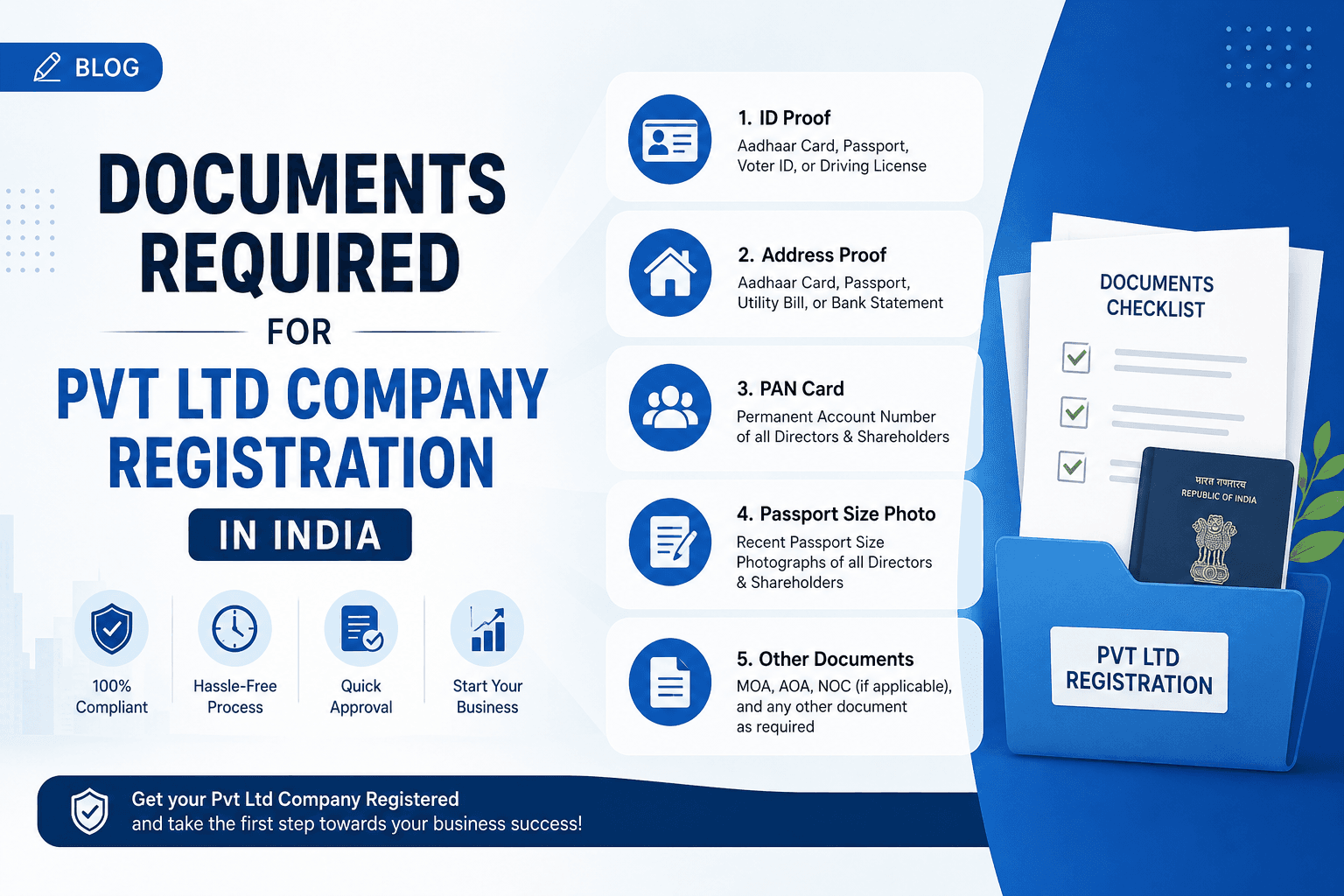
Documents Required for Directors and Shareholders
A Private Limited Company requires a minimum of 2 directors and 2 shareholders under the Companies Act 2013 (India’s primary legislation governing company formation and management). Directors and shareholders can be the same individuals. Let’s break this down into what each person must submit.
Identity Proof (Any One)
- PAN Card — mandatory for all Indian nationals; the name must match exactly across all other documents
- Passport — mandatory for foreign nationals and NRIs; must be valid and notarised if issued outside India
Address Proof (Any One)
- Aadhaar Card
- Voter ID
- Driving Licence
- Passport (can double as address proof if it carries current address)
Residential Proof (Any One — must not be older than 2 months)
- Bank statement
- Electricity bill
- Mobile or telephone bill
- Gas bill
Every director also needs a Digital Signature Certificate (DSC) — an encrypted electronic key used to sign MCA forms online — and a Director Identification Number (DIN), a unique 8-digit government-issued ID for every company director in India.
The DSC is obtained from MCA-approved certifying authorities. For those with an Aadhaar linked to a mobile number, DSC issuance is significantly faster through OTP-based verification.
You’ll also need 2–3 recent passport-sized photographs per director and shareholder. Keep digital scans ready in JPEG format under 1MB — MCA portals have strict upload size limits.
Registered Office Documents: What MCA Actually Wants
Every company registered in India must have a registered office address within the country — and MCA accepts both residential and commercial properties. The documents you need depend on whether the property is rented or owned. This is one of the most common stumbling blocks for first-time founders, so get it right from the start.
For a Rented Property
- Rent agreement or lease deed (signed by both landlord and tenant)
- No Objection Certificate (NOC) from the property owner — a written letter saying the owner permits the premises to be used as a registered office
- Latest utility bill (electricity, water, or gas) in the owner’s name — not older than 2 months
For an Owned Property
- Ownership deed or sale deed
- Latest utility bill in the owner’s name — not older than 2 months
A quick example: if you’re using your parent’s home in Mumbai as your registered office, you’ll need an NOC signed by your parent (the owner), your rent agreement or a simple permission letter, and a recent utility bill from that address. Many founders in Bengaluru and Delhi use co-working spaces as their registered office — that’s valid too, but get the NOC and utility bill from the co-working company on their letterhead.
Incorporation Documents: MOA, AOA, and SPICe+ Forms
Beyond identity and address, you need a set of constitutional and statutory documents that formally define your company. These are drafted and filed as part of the SPICe+ process on MCA21.
Memorandum of Association (MOA)
The MOA is the charter document of your company. It defines what your company is — its name, registered state, the liability of members, authorised share capital, and most critically, its objects clause (what your business will actually do).
Under the Companies Act 2013, your company can only legally carry out activities described in the MOA’s objects clause. If you plan to do e-commerce and also provide software services, both need to be captured. It is filed as INC-33 (eMoA) as part of the SPICe+ linked form set.
Articles of Association (AOA)
The AOA is your company’s internal rulebook. It governs how the company is managed — how directors are appointed, how shares are transferred, how meetings are conducted, and how decisions are made. It is filed as INC-34 (eAoA). Both MOA and AOA must be digitally signed by all subscribers (founding members).
Other Statutory Forms Filed via SPICe+
- INC-9 — Declaration by each proposed director and subscriber confirming they are not disqualified under the Companies Act 2013
- DIR-2 — Consent to act as director
- AGILE-PRO-S — Linked form for simultaneous GST registration, EPFO/ESIC registration, and bank account opening (filed together with SPICe+)
Once all forms and documents are filed correctly, MCA issues a Certificate of Incorporation (COI) along with the company’s CIN (Corporate Identity Number — a 21-digit alphanumeric code that uniquely identifies your company), PAN, and TAN. The typical timeline, as per registrar data, is 7–15 working days for complete applications.
Document Checklist by Business Structure
The core documents remain consistent, but each business structure has a few specific requirements. Here’s a quick comparison before you decide which structure to register under.
Private Limited Company (Pvt Ltd)
- Minimum 2 directors’ KYC documents (PAN, address proof, residential proof, photographs)
- DSC for each director
- DIN (auto-generated through SPICe+ if not already held)
- MOA (INC-33) + AOA (INC-34)
- INC-9 declarations from all subscribers and directors
- Registered office proof (rent agreement / NOC / utility bill)
One Person Company (OPC)
- Same as Pvt Ltd but only 1 director and 1 shareholder required
- Nominee’s PAN and consent (filed via Form INC-3) — the nominee takes over if the sole member becomes incapacitated
Limited Liability Partnership (LLP)
- Minimum 2 Designated Partners’ documents (same KYC as above)
- Filed through FiLLiP (Form for Incorporation of Limited Liability Partnership) on MCA21
- LLP Agreement — must be executed and filed within 30 days of incorporation
Documents for NRIs and Foreign Nationals
Foreign nationals and NRIs can incorporate a Private Limited Company in India under the FDI (Foreign Direct Investment) policy through the automatic route in most sectors. The document requirements differ in one key area: notarisation and apostille.
- Passport — valid, and notarised by a Notary Public in the country of residence; if from a Hague Convention country, it also needs an Apostille stamp
- Address proof — overseas bank statement or utility bill, notarised and apostilled
- Visa copy and date-of-entry stamp — if the foreign national is currently in India at the time of signing
- DSC — obtainable in India from MCA-empanelled agencies even for foreign nationals
The short answer: if even one director is a foreign national, plan for an extra 2–3 weeks for notarisation and apostille. Use that time to draft your MOA and AOA carefully.
5 Document Mistakes That Cause MCA Rejections
These are the actual reasons applications get sent back. Each one is avoidable if you know what to check.
- Name mismatch — PAN says one thing, Aadhaar says another. MCA treats even minor abbreviation differences as discrepancies.
- Expired utility bill — address proof for registered office and residential proof for directors must not be older than 2 months from the date of filing.
- Missing NOC from property owner — especially common when founders use a home address; the landlord or parent’s NOC is non-negotiable.
- Wrong objects clause in MOA — a fintech startup that lists only “software development” in its MOA cannot legally collect payments. The objects clause must match your actual business model.
- DSC not linked to Aadhaar — if your DSC is not Aadhaar-linked and your OTP verification fails, the entire submission is held up.
Frequently Asked Questions
Q: What is the most important document for company registration in India?
A: The PAN card is the most critical identity document for Indian nationals registering a company in India, as it links all tax filings to your company and directors. Without a valid PAN for each director and shareholder, the MCA will not process your SPICe+ application. For foreign nationals, a notarised and apostilled passport serves this function.
Q: Can I use a residential address as a registered office for my company in India?
A: Yes, MCA allows a residential address as the registered office of a company. You’ll need a No Objection Certificate (NOC) from the owner of the property, a rent agreement or permission letter, and a utility bill in the owner’s name not older than 2 months. Many early-stage founders in cities like Bengaluru and Mumbai use their home addresses before moving to commercial office space.
Q: How long does company registration take in India if all documents are correct?
A: When all documents are complete, correctly formatted, and names match across all proofs, most Private Limited Company registrations are approved by MCA within 7–15 working days. Incomplete applications or those flagged for resubmission can take significantly longer — sometimes 4–6 weeks. Submitting a clean, verified application the first time is the single biggest factor in a fast registration.
Q: What documents does a foreign national need to register a company in India?
A: A foreign national needs a valid passport (notarised and apostilled if from a Hague Convention country), overseas address proof (bank statement or utility bill — also notarised), and a Digital Signature Certificate. If the foreign national is in India at the time of signing, a visa copy and entry stamp are also required. At least one director of the company must be an Indian resident under the Companies Act 2013.
Q: Is Aadhaar mandatory for company registration in India?
A: Aadhaar is not strictly mandatory, but it significantly speeds up the process. An Aadhaar linked to a registered mobile number allows OTP-based DSC generation and simplifies KYC verification on the MCA21 portal. Without Aadhaar, directors must submit alternative address proofs (Voter ID, Driving Licence, Passport) and the DSC process may take longer through biometric verification.
Q: What is the difference between MOA and AOA in company registration?
A: The Memorandum of Association (MOA) is your company’s external-facing charter — it defines the company’s name, registered state, business objectives, and authorised share capital. The Articles of Association (AOA) is your internal rulebook — it governs how the company is run, how directors are appointed, and how decisions are made. Both are mandatory for Private Limited Company registration and must be filed as digitally signed documents on the MCA21 portal via the SPICe+ form.
Q: Do I need a separate document for GST registration when incorporating a company?
A: Not necessarily. The AGILE-PRO-S form, filed as part of the SPICe+ bundle, allows you to apply for GST registration simultaneously with company incorporation. This means the same set of KYC and address documents you submit for MCA can be used for GST registration as well, avoiding duplicate paperwork. However, if your business is not yet liable for GST at incorporation time, you can skip this and register for GST separately once your turnover crosses the applicable threshold.
Ready to register your company without the document headache? Lawizer’s experts handle everything — document verification, DSC procurement, SPICe+ filing, and MCA follow-ups — fully online, starting at just ₹1,499. No CA visit needed.
Start Your Company Registration with Lawizer → lawizer.com/startup-businesslegal