The Founder’s Guide to Vesting Schedules: Protecting Your Equity the Right Way
📌 TL;DR: A founder vesting schedule in India means promoters earn their shares over time — typically 4 years with a 1-year cliff — instead of receiving 100% ownership on day one. It protects the company from “dead equity” if a co-founder exits early, signals discipline to investors, and is enforced through a shareholders’ agreement […]
What You’ll Learn
- What founder vesting actually means and why it differs from employee ESOP vesting
- The standard 4-year, 1-year cliff structure Indian investors expect to see
- How reverse vesting works for founders who already hold shares
- Which clauses your founders’ agreement or SHA must include
- What happens to unvested equity when a co-founder leaves
What Is a Founder Vesting Schedule?
A vesting schedule is the timeline over which a founder “earns” full legal ownership of the shares allotted to them, rather than owning everything outright the moment the company incorporates. Here’s the key point: once a company allots shares under the Companies Act, 2013, the shareholder becomes their legal owner.
Vesting does not change ownership directly. Instead, it operates through a contractual mechanism in the founders’ agreement or Shareholders’ Agreement (SHA). This provision requires a departing founder to sell back any unvested shares.
The term “reverse vesting” refers to an arrangement where the founder already holds the shares and must transfer the unearned portion back if they exit early. Unlike an employee, who earns options that vest over time, the founder starts with the shares and gives back the unearned portion if they leave before the vesting period ends.
Many founders believe vesting only benefits investors. In reality, it also protects co-founders from day one. It safeguards both the founders and the company’s cap table. A four-year vesting period with a one-year cliff is now the standard in India and globally. A cliff is the initial period during which no equity vests.
Why Indian Founders Can’t Afford to Skip It
What’s the real cost of skipping vesting? Picture an equal three-way split with no agreement. One founder leaves after eight months. The remaining two now need that person’s consent for almost every shareholder-level decision — share issuance, a new funding round, even routine governance — because they still legally hold their full stake.

This isn’t a rare scenario. Disputes over undocumented equity promises and dormant cap table entries are among the most common founder-side legal issues Indian startups bring to law firms once a funding round is in motion. A co-founder who went passive — moved abroad, became inactive, or simply stopped contributing — can still hold pre-emptive and anti-dilution rights that block a Series A from closing on time.
The short answer: A founder vesting schedule turns a potential equity dispute into a pre-agreed contractual outcome. Without it, founders often face legal disputes later. These cases may end up before the National Company Law Tribunal (NCLT) under Sections 241–242 of the Companies Act, 2013.
The Standard Structure: 4-Year Vesting, 1-Year Cliff
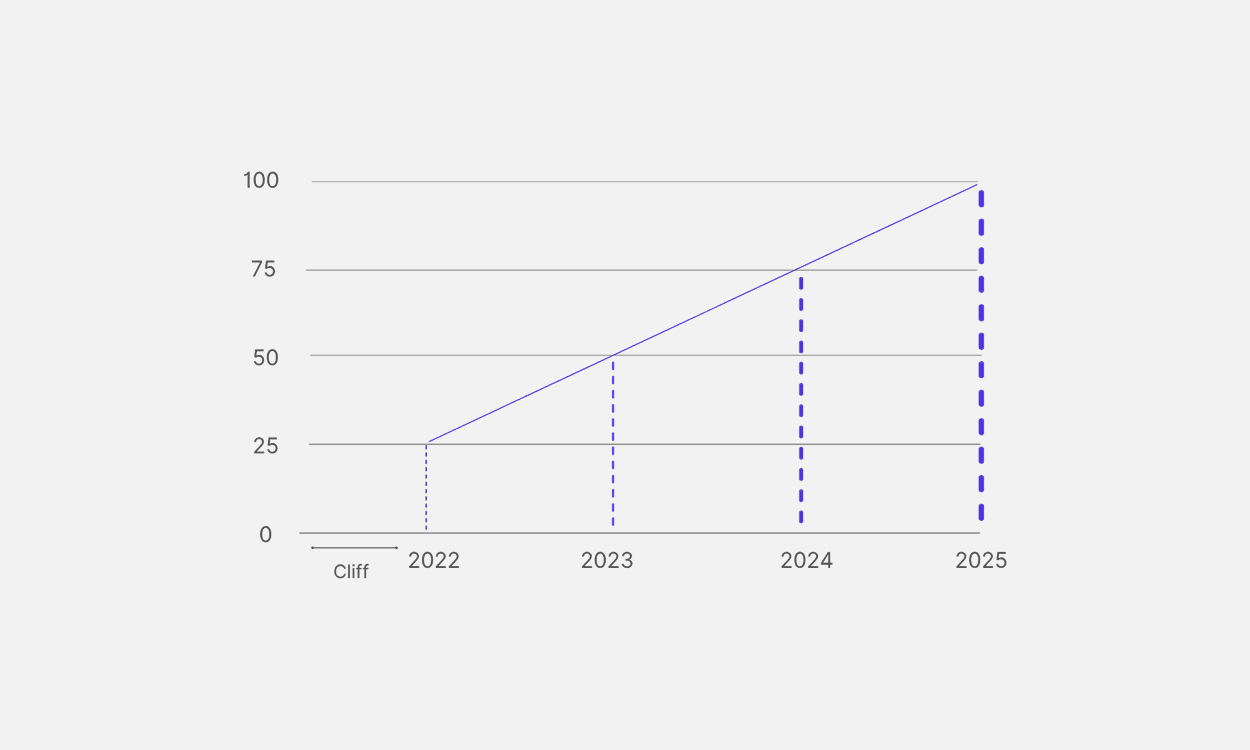
Let’s break this down. The structure almost every Indian startup and investor expects looks like this:
- Year 0–1 (the cliff):No shares vest. If a founder leaves before the 12-month mark, they walk away with nothing.
- End of Year 1: 25% of the founder’s shares vest in one go.
- Year 1–4: The remaining 75% vests monthly, in equal instalments — roughly 1/36th each month.
- Year 4 : The founder becomes fully vested and owns their entire allotted stake outright.
Founders who complete significant pre-incorporation work can negotiate vesting credit, allowing them to start partially vested on day one instead of beginning at zero. This is reasonable when documented, but it should be the exception, agreed in writing, not assumed.
Acceleration Clauses Worth Knowing
Acceleration speeds up vesting if a specific event occurs, usually an acquisition. Double-trigger acceleration offers a more balanced approach because it requires both an acquisition and a termination without cause before equity accelerates. This structure prevents founders from cashing out immediately after a deal closes and walking away, while still protecting them if the new owner later terminates them without cause.
Drafting It Right: What Your Founders’ Agreement Must Cover
A vesting clause that’s vague is almost as risky as having none. A quick example: an agreement that says shares vest “over time” without defining the cliff, the monthly schedule, or what counts as a “good leaver” versus a “bad leaver” leaves every term open to dispute later.
At minimum, your founders’ agreement or SHA should define:
- Exact vesting schedule: cliff length, total vesting period, and vesting frequency (monthly is most common).
- Good Leaver vs. Bad Leaver: The company repurchases unvested shares at fair value when a founder qualifies as a good leaver (for example, due to resignation, health reasons, or mutual agreement). However, the company repurchases those shares at face value or nil value when a founder becomes a bad leaver because of termination for cause or a breach of the agreement.
- Valuation mechanism for buyback: who values the unvested shares, and by when. Without this, parties default to Rule 11UA of the Income Tax Rules, 1962 — a method built for tax compliance, not equitable founder buyouts.
- IP assignment: a separate but related clause ensuring all IP built by founders, including pre-incorporation work, sits with the company, not the individual.
- Deadlock resolution: what happens if co-founders can’t agree on a reserved matter, including a forced transfer trigger for serious breaches.
Getting these clauses drafted correctly at incorporation is far cheaper than fixing them later. Lawizer’s company incorporation services include founders’ agreement drafting with vesting built in from day one, so you’re not retrofitting protection after a co-founder relationship has already gone sideways.

Founder Vesting vs ESOP Vesting: Don’t Confuse the Two
Here’s a distinction that trips up a lot of founders. Section 62(1)(b) of the Companies Act, 2013, along with Rule 12 of the Companies (Share Capital and Debentures) Rules, 2014, governs Employee Stock Option Plans (ESOPs) in India.
Rule 12 generally prohibits promoters and directors holding more than 10% equity from receiving ESOPs. However, companies recognised as startups under the Startup India initiative by DPIIT can grant ESOPs to these individuals, as the exemption remains available for up to 10 years from the date of incorporation.
In contrast, founder vesting does not operate under an ESOP scheme. Instead, founders receive their shares through a separate ownership arrangement. It’s a contractual obligation in the founders’ agreement or SHA that applies to shares already allotted to promoters at incorporation. The two mechanisms achieve a similar goal — earning equity over time — but they sit in completely different legal frameworks, and confusing them in your documentation is a common drafting mistake.
If you’re also setting up an employee option pool alongside founder vesting, make sure your MSME and compliance registrations are in place first — investors will check both during diligence.
What Happens When a Co-Founder Leaves Early
A quick example to make this concrete: a founder holding 30% equity leaves at the end of Year 2, with a standard 4-year/1-year-cliff schedule in place. They’ve vested 25% (the cliff) plus 12 months of monthly vesting — roughly 50% of their total grant.
The other 50% reverts to the company, typically at face value or nil consideration as specified in the buyback clause, and can be reallocated to a replacement co-founder, added to the ESOP pool, or held by the company.
What most founders miss: if the agreement is silent on the buyback price for unvested shares, the default valuation route is Rule 11UA — net asset value or discounted cash flow — which was designed for income tax compliance, not for a fair founder exit. Specifying the valuation method and timeline in writing at the start avoids a costly negotiation later.
When Should You Set Up Vesting?
The short answer: at incorporation, before any institutional money comes in. Investors increasingly check for a vesting schedule and a documented founders’ agreement during diligence, and discovering its absence mid-term-sheet negotiation is a red flag that can delay or derail a round.
If you’ve already incorporated without one, it’s not too late — but it does require every co-founder to agree to retroactively place their existing shares under a vesting arrangement, which is a harder conversation than setting it up on day one. Either way, this sits alongside your other founder-stage filings, including your company’s annual income tax return filing and trademark protection for your brand.
Frequently Asked Questions
A: No, the Companies Act, 2013 does not mandate founder vesting. It’s a contractual protection built into your founders’ agreement or SHA, not a statutory requirement. However, most institutional investors will insist on it before closing a funding round.
A: Vesting typically refers to options or shares granted to employees that they earn over time before receiving them. Reverse vesting applies to founders who already hold their shares; if they leave early, the unvested portion is sold back to the company. Founder agreements almost always use reverse vesting.
A: Yes. A 2-3 year vesting schedule with a shorter cliff is more founder-friendly and is sometimes accepted by early-stage investors, especially if the founder has already demonstrated significant traction. The 4-year, 1-year-cliff structure remains the default investors expect, so any deviation should be clearly justified and documented.
A: This depends entirely on your “bad leaver” clause. Most agreements specify that unvested shares are forfeited at nil or face value in a for-cause termination, while vested shares may still be repurchased at fair value or retained, depending on the agreement’s terms. Without this clause defined in writing, the company has no automatic right to claw back shares.
A: Generally no — founder equity is diluted as new shares are issued, but the original vesting timeline continues unchanged unless all parties specifically negotiate otherwise. Series A investors sometimes ask for renegotiated or restarted vesting as a condition of the round, which founders should review carefully before agreeing.
A: A solo founder has no co-founder to protect against, but investors will still often require founder vesting before funding, since it protects them against the founder leaving the company early post-investment. It’s worth setting up even for a single-founder startup if outside funding is on the roadmap.
Lawizer’s experts handle everything — founders’ agreement drafting, vesting schedule structuring, and full company incorporation — fully online, starting at just ₹1,499. No CA visit needed.
Three founders. One equal 33% split. No vesting schedule. Eighteen months later, one co-founder stops contributing but still owns one-third of the company. Many founders make the mistake of skipping a founder vesting schedule. At Lawizer, we have seen this happen often. This single document helps prevent future ownership disputes.
Eighteen months later, one co-founder stops contributing. However, they still own one-third of the company. Many founders make the mistake of skipping a founder vesting schedule.cision you make.
What You’ll Learn
- What founder vesting actually means and why it differs from employee ESOP vesting
- The standard 4-year, 1-year cliff structure Indian investors expect to see
- How reverse vesting works for founders who already hold shares
- Which clauses your founders’ agreement or SHA must include
- What happens to unvested equity when a co-founder leaves
What Is a Founder Vesting Schedule?
A vesting schedule is the timeline over which a founder “earns” full legal ownership of the shares allotted to them, rather than owning everything outright the moment the company incorporates. Here’s the key point: once a company allots shares under the Companies Act, 2013, the shareholder becomes their legal owner.
Vesting does not change ownership directly. Instead, it operates through a contractual mechanism in the founders’ agreement or Shareholders’ Agreement (SHA). This provision requires a departing founder to sell back any unvested shares.
The term “reverse vesting” refers to an arrangement where the founder already holds the shares and must transfer the unearned portion back if they exit early. Unlike an employee, who earns options that vest over time, the founder starts with the shares and gives back the unearned portion if they leave before the vesting period ends.
Many founders believe vesting only benefits investors. In reality, it also protects co-founders from day one. It safeguards both the founders and the company’s cap table. A four-year vesting period with a one-year cliff is now the standard in India and globally. A cliff is the initial period during which no equity vests.
Why Indian Founders Can’t Afford to Skip It
What’s the real cost of skipping vesting? Picture an equal three-way split with no agreement. One founder leaves after eight months. The remaining two now need that person’s consent for almost every shareholder-level decision — share issuance, a new funding round, even routine governance — because they still legally hold their full stake.
This isn’t a rare scenario. Disputes over undocumented equity promises and dormant cap table entries are among the most common founder-side legal issues Indian startups bring to law firms once a funding round is in motion. A co-founder who went passive — moved abroad, became inactive, or simply stopped contributing — can still hold pre-emptive and anti-dilution rights that block a Series A from closing on time.
The short answer: A founder vesting schedule turns a potential equity dispute into a pre-agreed contractual outcome. Without it, founders often face legal disputes later. These cases may end up before the National Company Law Tribunal (NCLT) under Sections 241–242 of the Companies Act, 2013.
The Standard Structure: 4-Year Vesting, 1-Year Cliff
Let’s break this down. The structure almost every Indian startup and investor expects looks like this:
- Year 0–1 (the cliff):No shares vest. If a founder leaves before the 12-month mark, they walk away with nothing.
- End of Year 1: 25% of the founder’s shares vest in one go.
- Year 1–4: The remaining 75% vests monthly, in equal instalments — roughly 1/36th each month.
- Year 4 : The founder becomes fully vested and owns their entire allotted stake outright.
Founders who complete significant pre-incorporation work can negotiate vesting credit, allowing them to start partially vested on day one instead of beginning at zero. This is reasonable when documented, but it should be the exception, agreed in writing, not assumed.
Acceleration Clauses Worth Knowing
Acceleration speeds up vesting if a specific event occurs, usually an acquisition. Double-trigger acceleration offers a more balanced approach because it requires both an acquisition and a termination without cause before equity accelerates. This structure prevents founders from cashing out immediately after a deal closes and walking away, while still protecting them if the new owner later terminates them without cause.
Drafting It Right: What Your Founders’ Agreement Must Cover
A vesting clause that’s vague is almost as risky as having none. A quick example: an agreement that says shares vest “over time” without defining the cliff, the monthly schedule, or what counts as a “good leaver” versus a “bad leaver” leaves every term open to dispute later.
At minimum, your founders’ agreement or SHA should define:
- Exact vesting schedule: cliff length, total vesting period, and vesting frequency (monthly is most common).
- Good Leaver vs. Bad Leaver: The company repurchases unvested shares at fair value when a founder qualifies as a good leaver (for example, due to resignation, health reasons, or mutual agreement). However, the company repurchases those shares at face value or nil value when a founder becomes a bad leaver because of termination for cause or a breach of the agreement.
- Valuation mechanism for buyback: who values the unvested shares, and by when. Without this, parties default to Rule 11UA of the Income Tax Rules, 1962 — a method built for tax compliance, not equitable founder buyouts.
- IP assignment: a separate but related clause ensuring all IP built by founders, including pre-incorporation work, sits with the company, not the individual.
- Deadlock resolution: what happens if co-founders can’t agree on a reserved matter, including a forced transfer trigger for serious breaches.
Getting these clauses drafted correctly at incorporation is far cheaper than fixing them later. Lawizer’s company incorporation services include founders’ agreement drafting with vesting built in from day one, so you’re not retrofitting protection after a co-founder relationship has already gone sideways.
Founder Vesting vs ESOP Vesting: Don’t Confuse the Two
Here’s a distinction that trips up a lot of founders. Section 62(1)(b) of the Companies Act, 2013, along with Rule 12 of the Companies (Share Capital and Debentures) Rules, 2014, governs Employee Stock Option Plans (ESOPs) in India.
Rule 12 generally prohibits promoters and directors holding more than 10% equity from receiving ESOPs. However, companies recognised as startups under the Startup India initiative by DPIIT can grant ESOPs to these individuals, as the exemption remains available for up to 10 years from the date of incorporation.
In contrast, founder vesting does not operate under an ESOP scheme. Instead, founders receive their shares through a separate ownership arrangement. It’s a contractual obligation in the founders’ agreement or SHA that applies to shares already allotted to promoters at incorporation. The two mechanisms achieve a similar goal — earning equity over time — but they sit in completely different legal frameworks, and confusing them in your documentation is a common drafting mistake.
If you’re also setting up an employee option pool alongside founder vesting, make sure your MSME and compliance registrations are in place first — investors will check both during diligence.
What Happens When a Co-Founder Leaves Early
A quick example to make this concrete: a founder holding 30% equity leaves at the end of Year 2, with a standard 4-year/1-year-cliff schedule in place. They’ve vested 25% (the cliff) plus 12 months of monthly vesting — roughly 50% of their total grant.
The other 50% reverts to the company, typically at face value or nil consideration as specified in the buyback clause, and can be reallocated to a replacement co-founder, added to the ESOP pool, or held by the company.
What most founders miss: if the agreement is silent on the buyback price for unvested shares, the default valuation route is Rule 11UA — net asset value or discounted cash flow — which was designed for income tax compliance, not for a fair founder exit. Specifying the valuation method and timeline in writing at the start avoids a costly negotiation later.
When Should You Set Up Vesting?
The short answer: at incorporation, before any institutional money comes in. Investors increasingly check for a vesting schedule and a documented founders’ agreement during diligence, and discovering its absence mid-term-sheet negotiation is a red flag that can delay or derail a round.
If you’ve already incorporated without one, it’s not too late — but it does require every co-founder to agree to retroactively place their existing shares under a vesting arrangement, which is a harder conversation than setting it up on day one. Either way, this sits alongside your other founder-stage filings, including your company’s annual income tax return filing and trademark protection for your brand.
Frequently Asked Questions
A: No, the Companies Act, 2013 does not mandate founder vesting. It’s a contractual protection built into your founders’ agreement or SHA, not a statutory requirement. However, most institutional investors will insist on it before closing a funding round.
A: Vesting typically refers to options or shares granted to employees that they earn over time before receiving them. Reverse vesting applies to founders who already hold their shares; if they leave early, the unvested portion is sold back to the company. Founder agreements almost always use reverse vesting.
A: Yes. A 2-3 year vesting schedule with a shorter cliff is more founder-friendly and is sometimes accepted by early-stage investors, especially if the founder has already demonstrated significant traction. The 4-year, 1-year-cliff structure remains the default investors expect, so any deviation should be clearly justified and documented.
A: This depends entirely on your “bad leaver” clause. Most agreements specify that unvested shares are forfeited at nil or face value in a for-cause termination, while vested shares may still be repurchased at fair value or retained, depending on the agreement’s terms. Without this clause defined in writing, the company has no automatic right to claw back shares.
A: Generally no — founder equity is diluted as new shares are issued, but the original vesting timeline continues unchanged unless all parties specifically negotiate otherwise. Series A investors sometimes ask for renegotiated or restarted vesting as a condition of the round, which founders should review carefully before agreeing.
A: A solo founder has no co-founder to protect against, but investors will still often require founder vesting before funding, since it protects them against the founder leaving the company early post-investment. It’s worth setting up even for a single-founder startup if outside funding is on the roadmap.
Lawizer’s experts handle everything — founders’ agreement drafting, vesting schedule structuring, and full company incorporation — fully online, starting at just ₹1,499. No CA visit needed.