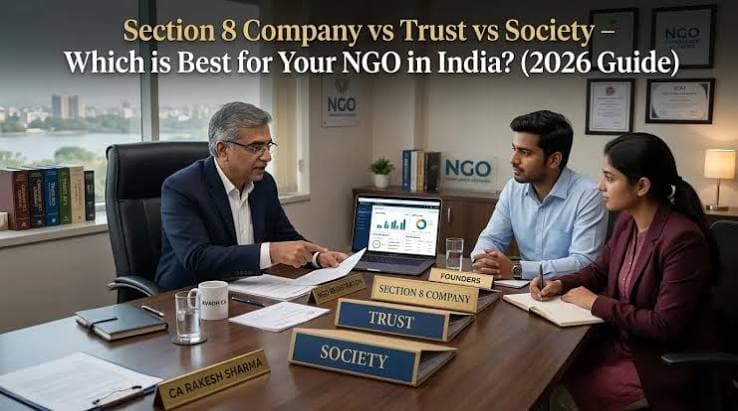
Section 8 Company vs NGO vs Trust: Which Structure Is Right for Social Startups?
Out of India’s roughly 1.87 lakh registered NGOs, only about 11,000 are Section 8 companies — the rest are trusts and societies. So if you’re picking a legal structure for your social startup, the popular choice isn’t always the right one for you. Get this wrong and you’ll either drown in compliance you didn’t need, […]
Out of India’s roughly 1.87 lakh registered NGOs, only about 11,000 are Section 8 companies — the rest are trusts and societies. So if you’re picking a legal structure for your social startup, the popular choice isn’t always the right one for you.
Get this wrong and you’ll either drown in compliance you didn’t need, or hit a funding wall you didn’t see coming.
TL;DR: Choosing between a Section 8 company, a Trust, and a Society comes down to three things — how much compliance you can handle, how big your funding ambitions are, and how much control you want to keep. Trusts are cheapest and simplest, Societies suit membership-driven groups, and Section 8 companies win on credibility for CSR and foreign funding. Lawizer helps social founders register and stay compliant with all three structures under one roof.
What You’ll Learn
- The real difference between a Section 8 company, a Trust, and a Society
- Which structure costs less to run every year
- How the new Income Tax Act 2025 changes tax treatment for all three
- A simple decision framework based on your startup’s scale and funding goals
Section 8 Company, Trust, and Society: What Each One Actually Is
Here’s the thing: “NGO” isn’t a legal structure at all. It’s an umbrella term. Every NGO in India is registered as one of three things — a Trust, a Society, or a Section 8 Company — and each answers to a different law.
A Trust is created under the Indian Trusts Act, 1882 (or your state’s public trust law), through a Trust Deed. A trustee holds assets on behalf of beneficiaries. You need just 2 trustees, there’s no elected body, and once trustees are in, they typically stay for life unless the deed says otherwise.
A Society is registered under the Societies Registration Act, 1860, and needs a minimum of 7 members plus a governing body that’s usually elected. It’s the go-to structure for membership-driven groups — alumni associations, cultural bodies, community welfare organisations.
A Section 8 Company is registered with the Ministry of Corporate Affairs (MCA) under the Companies Act, 2013. It functions like a private limited company — directors, MOA, AOA — except profits can never be distributed to members and must go back into the company’s charitable objects.
Cost and Compliance: The Number That Actually Matters
What most founders miss: the registration fee is a one-time cost. The compliance bill is the one that decides whether your structure survives year three.
A Trust’s annual compliance typically runs ₹5,000–₹15,000 — basic bookkeeping and an income tax filing, with no regulator breathing down your neck beyond that.
A Section 8 Company, on the other hand, usually costs ₹25,000–₹75,000 a year to keep compliant: statutory audits, annual ROC filings (AOC-4, MGT-7), board meeting records, and adherence to accounting standards.
A quick example: if your social startup runs on an annual budget under ₹25 lakh with two or three people managing it, that compliance overhead can eat a real chunk of your funds before a single rupee reaches your beneficiaries.
- Trust — cheapest, minimal ongoing paperwork, no regulator beyond Income Tax
- Society — moderate compliance, needs annual general meetings and elected renewals
- Section 8 Company — highest compliance, mandatory audits, ROC filings every year

Funding and Credibility: Where Section 8 Pulls Ahead
The short answer: if your growth plan involves corporate CSR money or foreign donors, a Section 8 Company gives you a real edge. Companies collectively spent over ₹1,84,222 crore on CSR between 2014 and 2023, and most large corporates prefer routing that money to Section 8 entities because their filings sit publicly on the MCA portal — donors can verify legitimacy without asking.
Trusts and Societies aren’t shut out of CSR or 80G benefits, but they lean on informal trust and local reputation rather than a public paper trail. That works well for grassroots and community-level work, but it slows you down the moment you’re pitching a national foundation or an overseas funder for a six-figure grant.
Setting up your business registration the right way from day one also makes it easier to layer on 12A and 80G approvals later, regardless of which structure you pick.
Income Tax Act 2025: The Rule That Changes Everything
Let’s break this down, because this is the part most 2024-era comparisons still get wrong. From 1 April 2026, the Income Tax Act 2025 introduces a unified “Registered Non-Profit Organisation” (RNPO) framework under its Chapter on non-profits — and it applies identically to Trusts, Societies, and Section 8 Companies.
Under this framework, all three structures file the same Form 10A for provisional registration (valid 3 years) and Form 10AB for regular registration (valid 5 years, or 10 years if income stays under ₹5 crore for two preceding years). The 85% income-application rule and cancellation grounds are also now identical across structures.
What this means practically: your choice of structure no longer changes your tax exemption eligibility. It only changes your governance model, your compliance workload, and how easily you can raise institutional money — which is exactly why the cost and credibility factors above matter more than ever.
So Which Structure Should Your Social Startup Pick?
Here’s a simple way to decide, based on where your startup actually is today — not where you hope it’ll be in five years.
- Choose a Trust if you’re a small, family-led, or founder-controlled initiative with a budget under ₹25 lakh and no near-term plans for CSR or foreign funding.
- Choose a Society if your work is membership-based — think alumni networks, cultural collectives, or community welfare groups that want democratic, elected leadership.
- Choose a Section 8 Company if you’re building for scale — planning to approach corporate CSR desks, apply for government grants, or eventually register under MSME as your social enterprise grows commercially alongside its charitable arm.
One more thing worth knowing: you can start as a Trust and move to a Section 8 Company later once you have traction — you can’t directly “convert” a Trust into one, but you can incorporate the Section 8 entity fresh and transfer operations across, subject to legal formalities.

Frequently Asked Questions
Q: Which is better, Trust or Section 8 company, for a small NGO?
A: For a small, founder-run NGO with a limited budget, a Trust is usually better because it costs less to set up and maintain every year. Move to a Section 8 Company once you’re actively pursuing CSR funding or foreign donations that require higher transparency.
Q: Can a Section 8 company have just 2 people running it?
A: Yes. A Section 8 Company needs a minimum of 2 directors and 2 subscribers, and the same two people can hold both roles. You’ll need Digital Signature Certificates (DSC) and Director Identification Numbers (DIN) for both, which adds roughly ₹2,000–₹4,000 to setup costs.
Q: Does the Income Tax Act 2025 change which structure I should pick?
A: Not directly on tax grounds. From 1 April 2026, Trusts, Societies, and Section 8 Companies all follow the identical RNPO registration process for tax exemption. Your structure choice should now be based on governance style, compliance capacity, and funding goals rather than tax benefits.
Q: Is a Section 8 company the same as an NGO?
A: A Section 8 Company is one type of NGO, not a synonym for it. NGO is the broad category; Trust, Society, and Section 8 Company are the three specific legal structures you can register an NGO under in India.
Q: Can I convert my existing Trust into a Section 8 company?
A: You cannot directly convert a Trust into a Section 8 Company under current law. Instead, you register a new Section 8 Company and transfer the Trust’s assets and operations to it, following the applicable legal and tax procedures.
Ready to register your social startup the right way? Lawizer’s experts handle Trust, Society, and Section 8 Company registration — plus 12A, 80G, and FCRA guidance — fully online, starting at just ₹4,999. No CA visit needed.